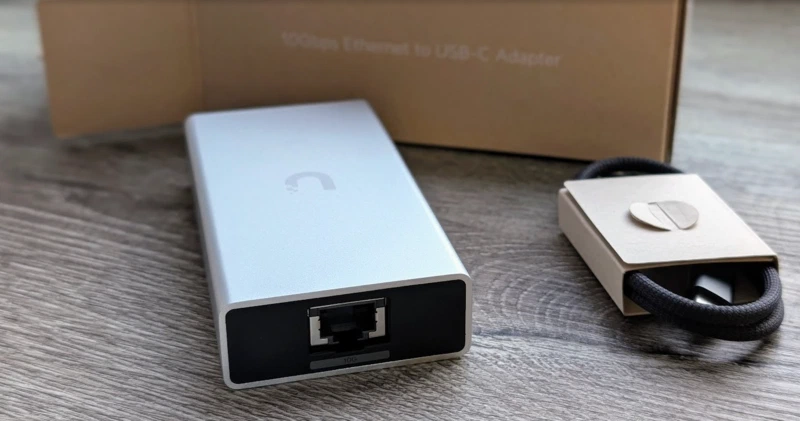
Got one Ubiquiti Unifi 10G Ethernet Adapter, model UACC-Adapter-RJ45-USBC-10GE. In the past, I’ve mostly got StarTech adapters for 10G Copper, but right now they’re either sold out or going for double the price. The Unifi 10G is 150€ plus tax, it fits what I need.
First off, it plugged right in on my Linux laptop running kernel 6.14 and a MacBook Air. No fuss with drivers or anything. Here’s what the kernel spit out on Linux:
thunderbolt 0-1: new device found, vendor=0xa5 device=0x27
thunderbolt 0-1: Ubiquiti Inc. UACC-Adapter-RJ45-USBC-10GE
thunderbolt 0-0:1.1: new retimer found, vendor=0x8087 device=0xd9c
pcieport 0000:00:07.0: pciehp: Slot(12): Card present
pcieport 0000:00:07.0: pciehp: Slot(12): Link Up
atlantic 0000:03:00.0 eth0: atlantic: link change old 0 new 10000
TCP: eth0: Driver has suspect GRO implementation, TCP performance may be compromised.
Speeds
It showed up as expected, and speeds looked good from the start. One thing to Note: this adapter only works on Thunderbolt 3 or 4. Forget about regular USB-C it won’t work.
Some blogs go negative about Adapters PCIe lane requirements, like how your host needs enough lanes to hit full speed. But in my case, that wasn’t a problem.
I pulled 9.37 Gbit with iperf3, and OpenSpeedTest clocked around 9.6 Gbit. That’s basically as good as it gets for 10G, considering overhead. I tested it hooked to a Unifi XG 10Gbit switch over a 10m CAT 7 cable with a default MTU of 1500.
### iperf3 -P 4
[ ID] Interval           Transfer     Bitrate         Retr
[  5]   0.00-10.00  sec  2.47 GBytes  2.12 Gbits/sec  764             sender
[  5]   0.00-10.00  sec  2.47 GBytes  2.12 Gbits/sec                  receiver
[  7]   0.00-10.00  sec  3.03 GBytes  2.60 Gbits/sec  657             sender
[  7]   0.00-10.00  sec  3.03 GBytes  2.60 Gbits/sec                  receiver
[  9]   0.00-10.00  sec  3.02 GBytes  2.59 Gbits/sec  752             sender
[  9]   0.00-10.00  sec  3.02 GBytes  2.59 Gbits/sec                  receiver
[ 11]   0.00-10.00  sec  2.39 GBytes  2.05 Gbits/sec  712             sender
[ 11]   0.00-10.00  sec  2.38 GBytes  2.05 Gbits/sec                  receiver
[SUM]   0.00-10.00  sec  10.9 GBytes  9.37 Gbits/sec  2885             sender
[SUM]   0.00-10.00  sec  10.9 GBytes  9.36 Gbits/sec                  receiver


### iperf3 -P 4 -R
[ ID] Interval           Transfer     Bitrate         Retr
[  5]   0.00-10.00  sec  2.74 GBytes  2.35 Gbits/sec  3820             sender
[  5]   0.00-10.00  sec  2.73 GBytes  2.35 Gbits/sec                  receiver
[  7]   0.00-10.00  sec  2.43 GBytes  2.09 Gbits/sec  3908             sender
[  7]   0.00-10.00  sec  2.42 GBytes  2.08 Gbits/sec                  receiver
[  9]   0.00-10.00  sec  2.76 GBytes  2.37 Gbits/sec  2279             sender
[  9]   0.00-10.00  sec  2.76 GBytes  2.37 Gbits/sec                  receiver
[ 11]   0.00-10.00  sec  2.99 GBytes  2.57 Gbits/sec  4103             sender
[ 11]   0.00-10.00  sec  2.99 GBytes  2.57 Gbits/sec                  receiver
[SUM]   0.00-10.00  sec  10.9 GBytes  9.38 Gbits/sec  14110             sender
[SUM]   0.00-10.00  sec  10.9 GBytes  9.37 Gbits/sec                  receiver
Features
It’s built on an AQC113 chip from Marvell, which handles the 10GBASE-T side. The chip is capable of doing Multigig NBASE-T at 10G/5G/2.5G/1G/100M/10M.
Feature wise some to note:
- 8 QoS Classes
- WoL
- LSO, RSS, DCA
- PTPv2
- Multigen PCI Express: 4>3>2
Build
It is build all metal, fanless, so it stays quiet. I’ve read other reviews where it hits 44-45°C under load, around 40°C idle, which matches what I noticed, gets warm but nothing crazy. It’s smaller than the StarTech TB 10G adapters I own a few of, so that’s a win for portability. But tbh. I normally not taking those on travel anyway.
All in all, a solid buy. If you’re eyeing a portable 10G upgrade and have the right ports, it’s worth considering.
Comments
Nothing is loaded from external services until you click.
With a Fediverse or Mastodon account you can reply to this post. Replies from any compatible server are shown below once loaded.
Mastodon replies
Web mentions
Leave a comment
Reply to this post on Mastodon and your reply will show up here.